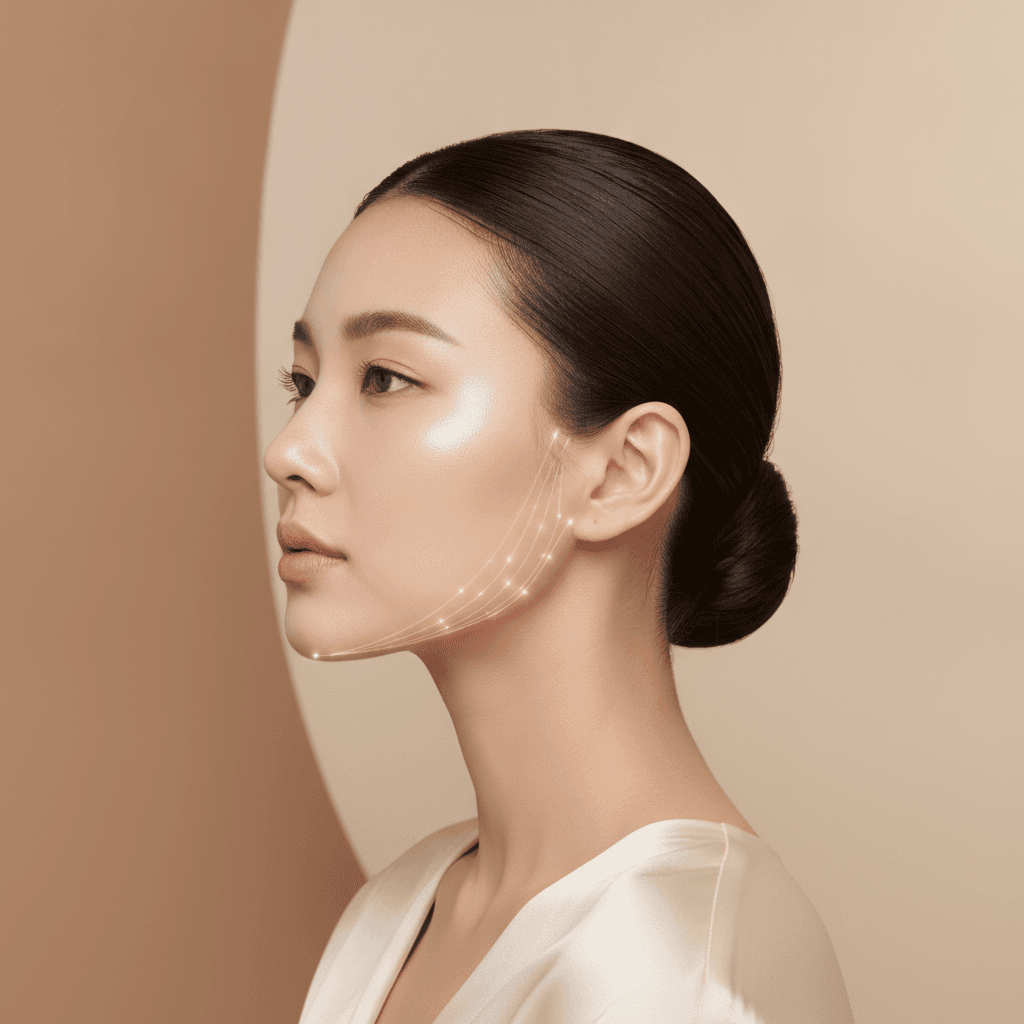
PDO Thread Lift: Smooth vs Cog Threads, Who Each Suits, and the Risks I Explain First
Dr. Hyunji Kim
2026-10-018 min read
Medically reviewed by Dr. Hyunji Kim · Last reviewed
I'm Dr. Hyunji Kim, director and lead physician at Delphic Clinic in Gangnam, near Sinnonhyeon Station. I trained at Korea University Medical Center and I am a member of the Korean Academy of Aesthetic Surgery & Laser Medicine and the Korean Filler Society. Lifting is the core of my practice, and I plan and place every thread myself, including every PDO thread lift we do.
Patients often write to me asking for a PDO thread lift as if it were one fixed procedure. In fact PDO is the material, and what it does depends on the thread you choose and where it goes. That one misunderstanding is behind many mismatched expectations, so this page is about the threads themselves: types, who suits each, how long they tend to last and the risks I go through before we start.
PDO is the material, not the procedure
Polydioxanone has been used for dissolvable sutures for many years. In a thread lift it is shaped into threads of different designs, and some clinics also use PLLA threads, a different dissolvable material. If you are new to thread lifts in general, the first-timer overview is in my thread lift Korea first-timer guide; here I stay on choosing between PDO thread types.
Smooth, cog and nose threads: what each design is built to do
The procedure takes about 40 to 80 minutes depending on the plan, and most people are back to ordinary activity within one to two days, with some swelling or tightness for longer.
Matching a PDO thread to the face in front of me
- Early jowls and a softening jaw line with decent skin thickness: cog threads are usually the right tool.
- Fine crepiness and dull, thin-feeling skin without real sagging: smooth mono threads make more sense than cogs.
- Deep nasolabial or marionette folds: threads for lift, with a small amount of filler to soften the fold itself.
- A low or flat nose bridge, or a tip that lacks definition: nose threads, which are a separate conversation.
How long a PDO thread lift lasts, framed honestly
The threads dissolve gradually. The visible lift from cog threads is clearest at first and softens as swelling settles and the threads are absorbed, while collagen formed around them helps support the skin for longer. Depending on the type of thread, the improvement in elasticity can last several months or longer. Your age, skin quality, how much sagging you start with and how you move your face all change that number, so I give you an estimate for your own plan, not a promise.
I choose the thread for the face, never the face for the thread. If the thread I have does not suit you, the answer is no thread.— Dr. Hyunji Kim, Delphic Clinic
The risks I explain before the first thread goes in
- Common and short-lived: swelling, bruising, tenderness, and tightness or a pulling feeling when you open your mouth wide or chew.
- Less common: small dimples or puckering at entry or anchor points, mild asymmetry, a thread end you can feel under the skin.
- Uncommon: infection, a thread that works towards the surface, or prolonged discomfort, which need a review and sometimes removal of the thread.
Reviews tend to understate how tight the first days feel and why a lift can look as if it dropped once swelling settles. I unpack both in my post on what thread lift reviewers miss.
Faces I would not thread
- Heavy sagging where threads alone would give a change too small to justify the cost.
- Very thin skin with little fat, where threads can show or cause visible ridges.
- An active skin infection, or a dental procedure or long-haul flight planned within the next day or two.
- Pregnancy, or a patient who needs a dramatic change that only surgery can give.
| Mint Thread 4 lines + Juvederm 1cc (Allergan) (Nasolabial or Marionette Line, choose 1) | ₩700,000$510 |
| Mint Thread 8 lines + Juvederm 1cc (Allergan) (Nasolabial or Marionette Line, choose 1) | ₩1,100,000$800 |
| Hiko Nose Bridge Thread 2 lines | ₩200,000$140 |
| Barbico Nose Tip Thread 2 lines | ₩200,000$140 |
| Jamber Thread 1 line | ₩120,000$90 |
| Mint Thread 1 line | ₩100,000$70 |
| Mono Thread 50 lines | ₩800,000$580 |
| High-Co 2 Lines | ₩200,000$140 |
| Bavicore 2 strands | ₩200,000$140 |
| 4 Mint Threads + 1cc Rejeuviel | ₩560,000$410 |
| 8 Mint Threads + 1cc Rejeuviel | ₩960,000$700 |
Copy these thread questions for your consultation
- Which thread type and brand will you use, and why that one for my face?
- How many lines, and where will the entry and anchor points be?
- What should I expect to see on day one, at two weeks, and later?
- Who places the threads, and what happens if I notice a dimple or a thread end?
Verified Google reviews
4.7 · 260 Google reviewsI received ONDA lifting and Juvelook Skin treatment at Delpic Clinic. Before the procedure, Dr. K carefully examined my skin condition and explained everything in a kind and easy-to-understand way, which made me feel very comfortable and reassured. During the treatment, I could really tell that Dr. K was highly skilled, so I felt confident and at ease throughout the entire process. Overall, I was very satisfied with my experience. It’s definitely a clinic I would love to visit again.
If you are considering a PDO thread lift, book a free one-to-one consultation. I will look at your skin and sagging, tell you which threads suit you, or that none do, and explain the risks before you decide. English and Chinese interpreters are on site, international patients pay the same price as Korean patients, and we are one minute from Exit 3 of Sinnonhyeon Station.
Get a free 1:1 consultation
Message our English-speaking team — same price as locals, no pressure.
Frequently asked questions
What is a PDO thread lift?
PDO (polydioxanone) is a dissolvable medical thread material. A PDO thread lift places these threads under the skin, either barbed cog threads that reposition sagging tissue or smooth threads that mainly support collagen and texture. The body gradually absorbs the threads.
What is the difference between smooth and cog PDO threads?
Cog threads have small barbs that hold tissue and give a lifting effect you can see straight away. Smooth, or mono, threads have no barbs; they are placed in larger numbers to firm skin and improve texture rather than lift. Many plans combine the two.
How long does a PDO thread lift last?
It depends on the thread type, the number of threads, your skin and how your body absorbs them. Generally, the effect lasts for several months, and with some thread types the improvement in elasticity can extend longer. I give you an estimate for your own plan rather than a single number.
What are the risks of a PDO thread lift?
Common effects are swelling, bruising, tenderness and tightness when opening the mouth wide. Less common issues include dimpling, asymmetry, a thread end that can be felt or seen, and infection. Careful planning and placement by a doctor lower these risks but cannot remove them.
How much is a PDO thread lift at Delphic?
Prices depend on the thread and number of lines, for example Mint Thread from 100,000 won per line and Mono Thread 50 lines at 800,000 won. The full price list is on this page, and international patients pay the same price as Korean patients.
Written by
Dr. Hyunji Kim
Dr. Hyunji Kim is the director and lead physician at Delphic Clinic in Gangnam, Seoul. She trained at Korea University Medical Center and personally performs consultations and procedures for both local and international patients.
Read next

Lifting
Thread Lift in Korea: How I Lift a Sagging Jawline Without Surgery — A Gangnam Doctor's Honest Guide
"Is a thread lift worth it, or should I just get a facelift?" I get asked this weekly. Here's my honest answer, from a Gangnam clinic.

Lifting
Thread Lift Korea: How I Lift Sagging Skin Without Surgery — A Gangnam Doctor's First-Timer Guide
"Will a thread lift make me look done?" I get this weekly. Here's the honest answer, from a Gangnam clinic.

Lifting
2 Weeks After Thread Lift: What Is Normal, What Is Not, and When to Message Your Clinic
Two weeks after a thread lift, most visible swelling has gone but the threads are still settling. A Gangnam doctor sorts normal from not, lists what is still off-limits, and explains when to message the clinic from home.