Red Mole: Cherry Spot, Small Blood Vessel or True Mole? What I Check Before Removing One

Dr. Hyunji Kim
2026-10-077 min read
Medically reviewed by Dr. Hyunji Kim · Last reviewed

I'm Dr. Hyunji Kim, director of Delphic Clinic in Gangnam, one minute from Sinnonhyeon Station Exit 3. I trained through Korea University Medical Center and I'm a member of the Korean Academy of Aesthetic Surgery & Laser Medicine and the Korean Society for Laser Dermatology & Hair, among others. My practice centres on lifting, laser and anti-aging, and I examine and remove small skin spots, including the occasional red mole, myself rather than handing them to a technician.
The red mole question comes up in my room most weeks, usually from someone pulling down a collar to show me a bright dot on the chest or shoulder. Some are worried it is dangerous; others simply want it gone before a beach holiday. In this post I explain why a red mole is often not a mole at all, which red spots I want to look at carefully before anyone touches them, and how removal is planned at Delphic.
If you are still deciding which of your spots are worth dealing with on a Korea trip, start with my guide to which moles suit a trip, because it sorts moles into lists before you book. This post goes narrower: only the red ones, and why they follow slightly different rules.
Why a red mole is often not a mole at all
A true mole gets its colour from pigment cells, which is why most moles are tan, brown or black. A bright cherry-red or ruby dot usually gets its colour from blood inside a tiny cluster of vessels. Doctors commonly call these cherry angiomas, and they tend to appear on the trunk and arms as people get older.
The difference matters for two reasons. First, the reassurance is different: a smooth, stable cherry spot is a very common finding. Second, the treatment is different, because a laser aimed at pigment and a laser aimed at blood vessels are not doing the same job. I covered the wider family of look-alikes in my piece on moles on skin and the common types, so here I stay with red.
A one-minute press test and photo log you can do tonight
You cannot diagnose a spot at home, and I would not want you to try. What you can do is gather useful information before a consultation. These checks take a minute and make my examination faster and more accurate.
- Press gently with a clear glass or the edge of a clear ruler. Note whether the red fades a little or stays the same.
- Photograph the spot next to a ruler in daylight, then repeat in four weeks. Keep the same angle and distance.
- Write down roughly when you first noticed it and whether it has bled without being scratched or knocked.
- Look at the colour honestly: one even red, or red mixed with dark brown, black or blue patches.
- Count how many similar red dots you have. Several matching ones is a different picture from one odd spot.
Red spots I want examined before anything is lasered
Some red spots are not a cosmetic question at all. If a spot is growing quickly, bleeding on its own, crusting repeatedly, changing shape, or mixing several colours, I want it properly evaluated before it is removed. In some of those cases the right step is a dermatology referral or a biopsy elsewhere, not a laser in my room.
Itching on its own is a separate topic, and if your red spot itches as well, read my note on when an itchy mole should be checked. The principle is the same: change over time is what I take seriously, not colour alone.
Laser, vessel setting or leave it: my three options for a red mole
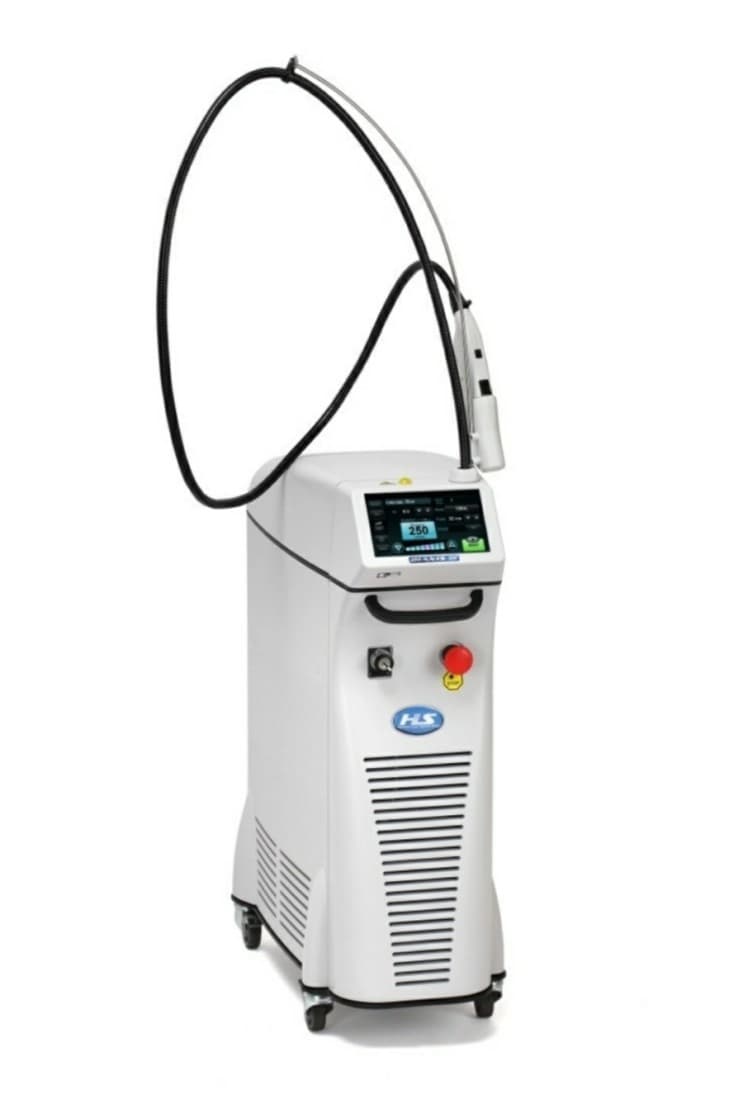
Once I have examined the spot, there are usually three paths. For many small, stable red dots, the mole-removal laser at Delphic, the Avvio laser, can treat the spot precisely while limiting heat to the surrounding skin. For some flatter vascular redness, a vessel-targeting setting such as the vascular mode on our GV laser may be the more fitting tool.
The third path is to leave it, and I choose that more often than people expect. If the spot is tiny, flat, hidden by clothing and not bothering you, removal adds a healing mark for little gain. I would rather tell you that than add one more spot to the bill.
I never pick the laser before I have looked at the spot under good light. The colour tells me where to start, not where to finish.— Dr. Hyunji Kim, Delphic Clinic
When I would tell you to skip red mole removal
- The spot is changing or bleeding and has not yet been evaluated. Evaluation comes first.
- You have a sunburn or a fresh tan over the area. I would wait until the skin has settled.
- You fly home within a day or two and the spot sits where a bag strap or waistband will rub it.
- You expect removal to stop new red dots from appearing. It treats the existing spots only.
- The dot is barely visible and you are removing it only because someone online said you should.
Fitting red spot removal into a Seoul stay
- 1
Bring your photos
Show me the photo log from your phone, especially if a spot has changed over the past months.
- 2
Examination and plan
I examine each red spot, separate cosmetic ones from those that need evaluation, and confirm the per-spot price.
- 3
Treatment, usually the same day
Small spots are typically treated in a short session of around 10 to 20 minutes after numbing.
- 4
First week of healing
Most small sites settle over roughly 3 to 7 days. Keep them clean, covered as advised and out of strong sun.

If you want to see what the healing stage really looks like day by day, my post on the healing nobody photographs walks through it honestly. Red spots on the body often take a little longer to fade than spots on the face.
| Mole Removal 1 Spot (2mm or less) | ₩10,000$10 |
| Mole Removal 1 Spot (over 2mm) - Price varies by size | ₩20,000$10 |
| Body Mole Removal 1 Spot (Varies by size) - Price for over 2mm varies by size | ₩20,000$10 |
| Milia/Wart/Skin Tag Removal 1 Spot (Varies by size) - Price for over 2mm varies by size | ₩20,000$10 |
| Mole removal (1 mole, 2mm or more) | ₩20,000$10 |
| Removal of 1 body mole (varies by size) | ₩20,000$10 |
| Removal of 1 seborrheic keratosis/wart/skin tag (varies by size) | ₩20,000$10 |
Copy these three questions into your message when you book, and you will get a much more useful answer: Is my red spot a mole or a vascular spot? Does anything about it need evaluation before removal? Which method and how many sessions do you expect for my spot size?
Verified Google reviews
4.7 · 260 Google reviewsI received ONDA lifting and Juvelook Skin treatment at Delpic Clinic. Before the procedure, Dr. K carefully examined my skin condition and explained everything in a kind and easy-to-understand way, which made me feel very comfortable and reassured. During the treatment, I could really tell that Dr. K was highly skilled, so I felt confident and at ease throughout the entire process. Overall, I was very satisfied with my experience. It’s definitely a clinic I would love to visit again.
I had a really great experience at Delphic Clinic. The staff were very friendly and made me feel comfortable from the moment I walked in. They explained everything clearly in English and didn’t try to oversell unnecessary treatments, which I really appreciated. The clinic is very clean and modern, and the whole process felt professional and well-organized. Overall, I would definitely recommend this clinic, especially if you’re a foreigner looking for a trustworthy place in Korea.
If you have a red mole you are unsure about, book a free 1:1 consultation and let me look at it before you decide anything. English and Chinese interpreters are on site, Korean and international patients pay the same price, and we are one minute from Sinnonhyeon Station Exit 3.

Get a free 1:1 consultation
Message our English-speaking team — same price as locals, no pressure.
Frequently asked questions
Is a red mole the same as a normal mole?
Often not. Many small, bright red dots on the chest, back or arms are cherry angiomas, which are clusters of tiny blood vessels rather than pigment cells. A doctor can usually tell the difference by looking closely, and that difference changes how the spot is removed.
Should I worry about a red mole?
A small, stable red dot that has looked the same for a long time is common. A red spot that is growing quickly, bleeding without being knocked, changing shape or mixing red with dark brown or black should be looked at by a doctor before any removal is planned.
Can a red mole be removed with a laser?
Many can. At Delphic I examine the spot first, then decide whether the mole-removal laser or a vessel-targeting setting suits it. Some red spots are better left alone or referred for further evaluation instead.
Will a red mole come back after removal?
The treated spot usually settles, but new red dots can appear elsewhere over the years, especially with age. Removal treats the spots you have now; it does not stop new ones from forming.
How much does red mole removal cost at Delphic?
Small spots are priced per spot by size on the mole-removal menu, and the same price applies to Korean and international patients. The exact quote is confirmed after I examine the spot.
Written by
Dr. Hyunji Kim
Dr. Hyunji Kim is the director and lead physician at Delphic Clinic in Gangnam, Seoul. She trained at Korea University Medical Center and personally performs consultations and procedures for both local and international patients.
Read next

Skin & acne
Korean Laser Skin Treatment Price: Our Laser Menu in Won, and What Changes the Bill
Korean laser skin treatment price depends less on the machine than on the unit you are paying for: a session, a mode, a full face or a five-pack. Here is our real laser menu in won and the factors that move the total.
Skin & acne
Raised Mole: Why Removing a Bump Is a Different Decision From Removing a Flat Spot
A raised mole is not just a bigger flat mole. A Gangnam doctor explains why depth changes the removal method, what that means for scarring, and who should have their mole evaluated before any removal.
Skin & acne
Skin Tag on Neck: How I Remove Them, What It Costs, and How to Care for Your Neck Afterwards
Skin tags on the neck are common, harmless-looking and easy to snag. A Gangnam doctor explains how to tell them from moles, why home removal goes wrong, how removal works at Delphic and how to care for the neck afterwards.